Welcome!
This is part of JCOWebsite and contains all the proposed...
In the game called Slitherlink, can you show all the details
proving that the following configuration is impossible ?
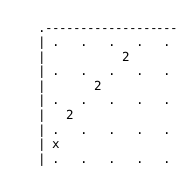
    My solution has a trivial initial observation, an easy Case 1 and Case 2 divided in two sub-cases)
    We analyze the possible outcomes from this configuration but can already discard all configurations
    in which the lower "2"-cell has vertical lines, or horizontal lines, in both edges.

    Also, this configuration

.-------------------
| .   .   .   .   .
|           2
| .   .   .   .   .
|       2
| .___.   .   .   .
| | 2
|A.   .   .   .   .
| x
| .   .   .   .   .

and this

.-------------------
| .   .   .   .   .
|           2
| .   .   .   .   .
|       2
| .   .   .   .   .
|   2 |
|A.___.   .   .   .
| x
| .   .   .   .   .

are clearly impossible (dead end at corner A).

Part 2

Case 1:

.-------------------
| .   .   .   .   .
|           2
| .   .   .   .   .
|       2
| .___.   .   .   .
|   2 |
| .   .   .   .   .
| x
| .   .   .   .   .

Now the following is forced

.-------------------
| .   .___.___.   .
|         x 2 |
| .   .___. x .   .
| |   x 2 |
| .___. x .   .   .
|   2 |
| .   .   .   .   .
| x
| .   .   .   .   .

and this leads to an impossibility in the cell at the corner, reached
by three lines.

Part 3

Case 2:

.-------------------
| .   .   .   .   .
|           2
| .   .   .   .   .
|       2
| .   .   .   .   .
| | 2
| .___.   .   .   .
| x
| .   .   .   .   .

The following is a forced move

.-------------------
| .   .   .   .   .
|           2
| .   .B  .   .   .
| |     2
| . x .A  .   .   .
| | 2 x
| .___.   .   .   .
| x
| .   .   .   .   .

Part 3.1

Case 2.1: If a vertical line exists at AB, it forces

.-------------------
| .   .   .   .   .
|     |     2
| .C  .   .   .   .
| |   | 2
| . x .___.D  .   .
| | 2 x
| .___.   .   .   .
| x
| .   .   .   .   .

and any continuation for the line meeting
corner C will create a loop (impossible).

Part 3.2

Case 2.2: the other possibility is to have the edge AB blocked, and then the bottom edge
AD of the "2"-cell in the middle needs to be blocked too, forcing the following
configuration to be reached.

.-------------------
| .   .___.___.   .
|         x 2 |
| .   .___. x .   .
| |   x 2 |
| . x . x .   .   .
| | 2 x
| .___.   .   .   .
| x
| .   .   .   .   .

Now, we have an impossible situation
in the cell at the corner, reached by three
lines.

(Using symmetry, the proven result establishes a well-known slitherlink pattern)
The following Jigsaw Sudoku Layout is invalid. Why ?
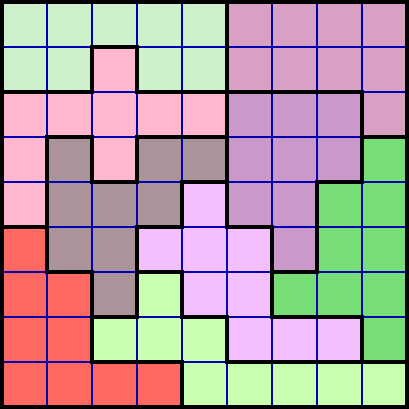
(image created using SudokuExplainer)
A Jigsaw Sudoku Layout is invalid if no Latin Squares exist for that Layouts.
Can you find a short, yet complete, explanation (no computations involved) ?
To my knowledge this question was first posed, and subsequently pursued, by Mathimagics.
Consider the following puzzle proposed by tarek at the NSPF in 2019.
See the hints for the grid after basics and NSPF link on ALP/ALT.
There is an Almost Locked Pair (ALP) that solves the puzzle with basics.
Part 1: Find the ALP and explain its logic in words (explanation given later at the hint section).
Part 2: Find an almost locked triple (ALT) that solves this puzzle (ste), and (the key part !)
find an explanation along the lines of the one given for Part 1.
Hope it will be fun, as it was for me some years ago.
link on ALP/ALT.
,-----------------------------------------------------------------------,
| 137     579    8     | 2356    1367    257  | 134     12579   123457  |
| 137     579    2     | 8       4       57   | 136     15679   1357    |
| 6       4      135   | 235     137     9    | 13      1257    8       |
|----------------------+----------------------+-------------------------|
| 8       3      9     | 4       5       6    | 2       17      17      |
| 2       1      4     | 7       9       8    | 5       3       6       |
| 5       6      7     | 1       2       3    | 8       4       9       |
|----------------------+----------------------+-------------------------|
| 134     2      1356  | 9       367     457  | 1346    8       1345    |
| 347     57     356   | 2356    8       1    | 9       256     2345    |
| 9       8      1356  | 2356    36      245  | 7       1256    12345   |
'-----------------------------------------------------------------------'
Update (Feb 9, 2026)
  ,-----------------------------------------------------------------------,
9 | 137     579    8     | 2356    1367    257  | 4-13    2579-1  123457  |
8 |(13)-7   579    2     | 8       4       57   |(13)6   (1)5679 (13)57   |
7 | 6       4      135   | 235     137     9    |(13)     257-1   8       |
  |----------------------+----------------------+-------------------------|
6 | 8       3      9     | 4       5       6    | 2       17      17      |
5 | 2       1      4     | 7       9       8    | 5       3       6       |
4 | 5       6      7     | 1       2       3    | 8       4       9       |
  |----------------------+----------------------+-------------------------|
3 | 134     2      1356  | 9       367     457  | 1346    8       1345    |
2 | 347     57     356   | 2356    8       1    | 9       256     2345    |
1 | 9       8      1356  | 2356    36      245  | 7       1256    12345   |
  '-----------------------------------------------------------------------'
  a       b      c       d       e       f      g       h       i

Almost locked pair (13)A,B,C where A=g8.h8.i8, B = g7, C = a8.
Let {a,b} be {1, 3}. If "a" is false at C, then (strong link) it must be true
at A, and the other digit "b" must be true at B. This explains the eliminations
at the top left box. The other elimination comes from the fact that we cannot
have a,b both out of C, because (strong link) they would be forced to be at A,
leaving (due to the weak link) the cell B empty.

So, the way to find this pattern directly [I often find it as a Loop] can be
to look at a bivalued cell and a mini-row (column) with those two digits and
see if it is strongly linked [in the Row (Column)] to a cell containing those
digits among its digits. This pattern appears a lot more than the ALT [Part 2].
Update (Feb 10, 2026)

I often find such move (ALP) in the form

Loop (1-3)a8 = (3)g8.i8 - (3=1)g7 - (1)g8.h8.i8 = (1-3)a8 => -13 g9.i9, -1 h7.h9, -7 a8; lclste

Regarding Part 2, the almost locked triple instead of the ALP solves the puzzle with singles
as follows:

.-----------------------------------------------------------------------------.
| 137     579     8       | 36-25   136-7  [257]    | 134     12579   123457  |
| 137     579     2       | 8       4      [57]     | 136     15679   1357    |
| 6       4      [5]-13   |(25)3    13(7)   9       | 13     (257)-1  8       |
|-------------------------+-------------------------+-------------------------|
| 8       3       9       | 4       5       6       | 2       17      17      |
| 2       1       4       | 7       9       8       | 5       3       6       |
| 5       6       7       | 1       2       3       | 8       4       9       |
|-------------------------+-------------------------+-------------------------|
| 134     2       1356    | 9       367     457     | 1346    8       1345    |
| 347     57      356     | 2356    8       1       | 9       256     2345    |
| 9       8       1356    | 2356    36      245     | 7       1256    12345   |
'-----------------------------------------------------------------------------'
ALT (257) r3c45,r3c38,r12c6 => -25 r1c4, -7 r1c5, -13 r3c3, -1 r3c8; ste

. What would be the Loop associated to this move ?

. Which other reasoning can explain the move (outside the scope of the next item) ?

. The key reason for this problem 3 is to ask for an explanation for this move
  along the lines given for ALP.

Problems are seen here as open-ended questions (not being mere exercises).
For this part no further comments will be made.
Consider the following chess problem.
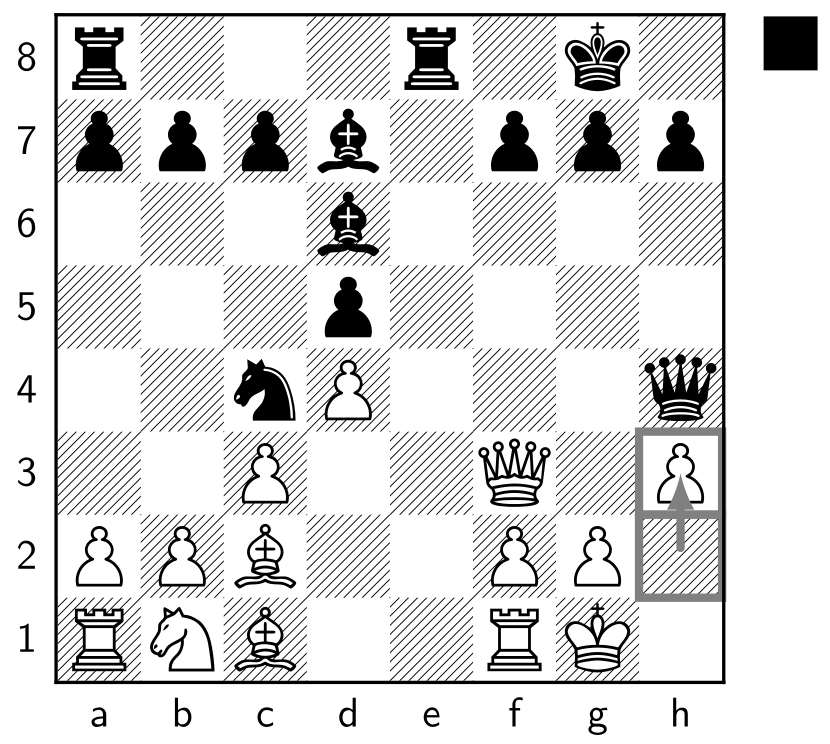
Black to play a powerful move and get an enduring initiative. Is it enough to win with correct play ?
15... Re4! is very pretty and strong! It "defends" d5 with the immediate threat is 16... Bg4, using
the mate theme at h2. White has to defend with great precision! How should white continue ? In particular,
should white take that rook ?

There are many possibilities and I was amazed by how gorgeous many of them turn out to be!

UPDATE (May 5, 2026): this is an open ended problem with many lines, but, for the start,
we must take the rook, but not immediately: 16.Bxe4?! dxe4 17.Qe2 Re8! and white is in trouble
because of the threat 18... Bxh3 [for instance, 18. Qxc4? Bxh3! wins], The Queen no longer helps
the defence. After 18.f4 e3! 19.b3 Nb6 and further analysis indicate that it is unlikely that
white can survive this. So, what to play instead of taking the rook ?

FINAL UPDATE (May 6, 2026): nearly forced is 16.g3! Qxh3 17.Bxe4 dxe4 18.Qh1 Qg4 and
white needs to continue with great precision.
Consider the following chess problem.
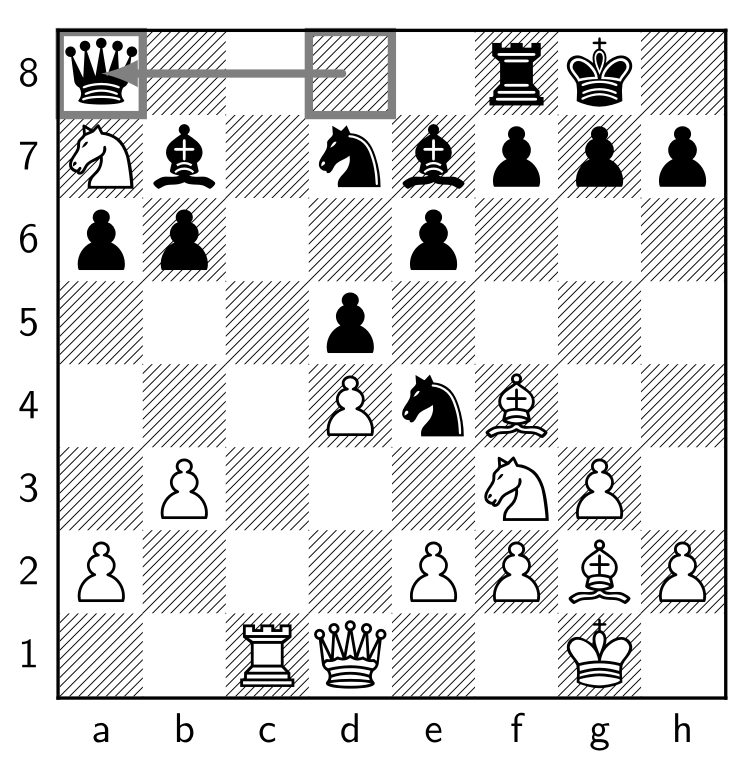
White has a knight trapped and must play sharply to avoid losing. How to do it ?
Update 1 (May 10, 2026)

Clearly 18. Rc7 is forced. Now, black can continue with
(a) 18. Nef6, or (b) 18... Rd8, or (c) 18... Bd8.

It is easy to see how to handle (a). However, (b), (c)
are much more interesting.
Update 2 (May 14, 2026)

(a) 18... Nef6 19. Ne5 and now 19... Nxe5, 19... Bd6 lead to a weak king
with the black queen too far away if black tries to keep rook for bishop
and a clear disadvantage otherwise.
A sample line is 19... Bd6 20.Nxd7 Bxc7 21.Nxf6+ gxf6 22.Bxc7 Qxa7 23.e4!
Again, the two other main lines (b), (c) are very interesting in this
open-ended problem.

For instance, for (c) 18... Bd8 (to trap the rook) 19.Rxd7 Nf6
20.Rxd8 Rxd8, and now, how to continue ?

EDIT: [For (b), after 18... Rd8, the next move is crucial]  ///
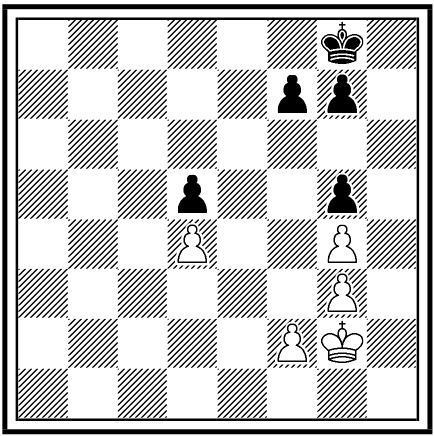
Consider the following chess position:
White: Kg2, f2, g3, g4, d4; Black: Kg8, g7, f7, g5, d5.
Now it is White's turn and White plays 1. Kf1.
What should be black's response ? How the game should continue with correct play ?
After 1.Kf1, 1.... Kh7! is the only move.

    .Interestingly, if the puzzle had black playing first, then
    [no Kf1 move] 1... Kf8 would win! Why ?

    . How the play could evolve [with correct play] after 1... Kh7!

    Final Update: in the second scenario (Black plays first), 1...Kf8
    wins because the pawn structure in the right-hand side allows black
    win the opposition of kings.

    Regarding the original problem, White playing 1.Kf1 will arrive early
    in the left side, winning the opposition, so Black must use the pawn
    configuration in the right-hand side to save the game, starting with
    1... Kh7!
In the next grid, find the maximum number of lines and forbidden edges possible.
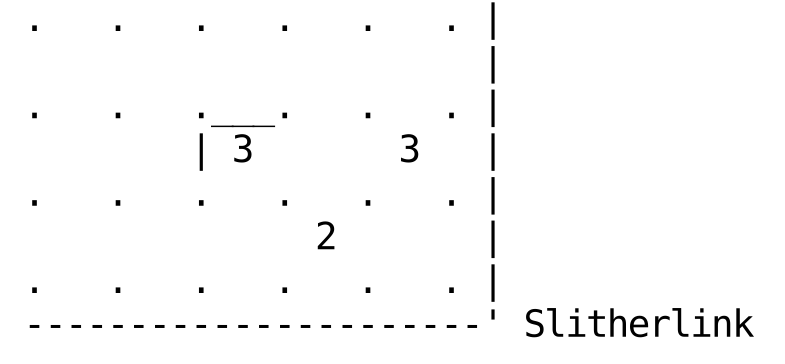
.   .   .   .   .   . |
                      |
.   .   .___.   .   . |
        | 3       3   |
.   .   .   .   .   . |
              2       |
.   .   .   .   .   . |
----------------------' SL

For the 3 with two lines already, there is a stable configuration
under any of the two possible ways to fulfill that cell.

Update (Oct 3, 2026): the implied pattern is shown below

.   .   .___.   .   . |    .   .   .___. x .___. |
        | 3       3   |            | 3     | 3   |
.   .   .   .   .   . |    .   .   .   .   .   . |
              2       | =>               2 x   | |
.   .   .   .   .   . |    .   .   .   .___.___. |
----------------------'    ----------------------'